

In the modern wellness landscape, we are obsessed with the gut. When bloating, erratic digestion, or food sensitivities flare up, our immediate instinct is to look at the plate. We reach for probiotics, eliminate food groups, and meticulously track our macros.
But as an Ayurvedic Doctor (ADLC), I often see clients who are eating a textbook-perfect, dosha-balancing diet, yet their digestive fires (Agni) remain entirely compromised.
The missing link isn't on the plate. It is in the mind.
In both Yoga and Ayurveda, the mind and the gut are not two separate entities connected by a bridge; they are reflections of the exact same stream of consciousness. When we experience spinning, erratic thoughts, we aren’t just creating mental static, we are physically altering the movement of life force (Prana) in our bodies, down-regulating the vagus nerve, and freezing our digestive capacity.
If you have been trying to heal your gut through food alone with little success, it is time to shift your focus upward.
The Yogic Concept of Mind: From Chitta Vritti to the Witness
To understand how thoughts become physical symptoms, we must look at how the Vedic sciences map the inner instrument, known as the Antahkarana.
The mind is not a single, monolithic entity. It operates in layers:
Manas: The sensory, processing mind. It coordinates inputs and is the home of our immediate, everyday thoughts.
Ahamkara: The ego-identity. The part of us that says, "This is happening to me."
Buddhi: The intellect and discerning wisdom.
Chitta: The deep storehouse of memory and subconscious impressions (samskaras).
Patanjali’s Yoga Sutras define the entire practice of yoga as Chitta Vritti Nirodha—the settling of the spinning fluctuations of the mind. When we are stressed, anxious, or hyper-focused on the future, the Manas loops endlessly in these Vrittis (whirlpools of thought).
The ultimate goal of Yoga is to step out of the whirlpool and establish ourselves in the state of the Witness (Purusha or Drashta). The Witness is the part of your consciousness that observes the thoughts without catching fire from them. When you are the Witness, you realize: I am experiencing a thought of anxiety, but I am not the anxiety.
How Spinning Thoughts Disturb Vata and the Vayus
When we fail to access the Witness state and instead let our thoughts spin, we directly aggravate Vata dosha, which is composed of air and space. Vata governs all movement in the mind and body.
Within Vata, there are five sub-doshas, known as the Prana Vayus—the directional currents of intelligence and life force. The two most critical Vayus for the mind-gut connection are:
Prana Vayu: The downward-and-inward movement of energy, centered in the head and chest. It governs the intake of everything: food, breath, thoughts, and sensory impressions.
Samana Vayu: The balancing, linear movement of energy centered in the small intestine. It governs the digestion and assimilation of both food and experiences.
When the mind spins with repetitive, anxious thoughts, Prana Vayu becomes hyper-mobile and erratic. Because the body is a continuous energetic loop, a chaotic Prana Vayu immediately derails Samana Vayu in the gut. The wind begins to blow erratically in the digestive tract.
Physically, this erratic energetic wind dries out the digestive fire (Agni), leading to the classic Vata-type digestive symptoms: sudden bloating, variable appetite, gas, constrictive cramping, and constipation.
The Modern Science: Prana, Vayu, and the Vagus Nerve
What Ayurveda describes as the flow of Prana and Vayu, modern neurology explains through the vagus nerve and the microbiome-gut-brain axis.
The vagus nerve is the superhighway of the parasympathetic nervous system (the "rest and digest" state). It originates in the brainstem, travels through the neck, and extensively branches out to the heart, lungs, and the entire digestive tract.
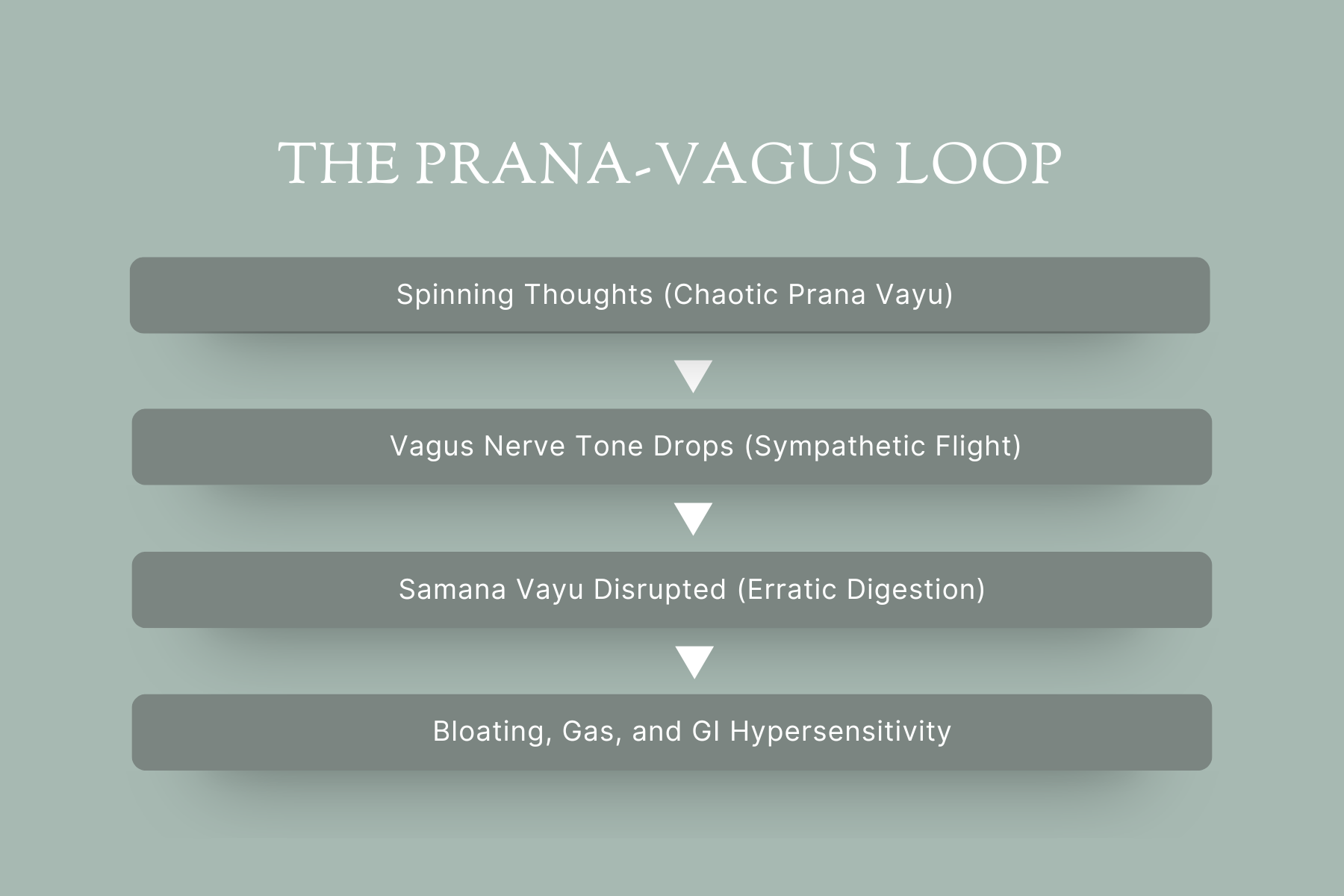
When you are stuck in spinning thoughts, your brain perceives a state of threat. The tone of the vagus nerve drops instantly. This shifts the body out of rest-and-digest and into a low-grade sympathetic (fight-or-flight) state.
When vagal tone is low:
Blood flow is diverted away from your stomach and intestines.
The production of stomach acid and digestive enzymes plummets.
The muscular contractions of the gut (peristalsis) either freeze completely or become hyper-spasmodic.
This is why your gut feels hyper-sensitive, bloated, or tied in knots. It isn't because you ate the wrong vegetable; it's because your nervous system has physically withdrawn the energy required to digest anything.
Moving Beyond the Plate: Healing the Gut by Calming the Mind
If your gut imbalances are born of a Vata-shattered mind, no amount of bone broth, elimination diets, or expensive supplements will bring lasting relief. Micro-managing your food can actually exacerbate the problem, as the hyper-vigilance of tracking food further aggravates Vata.
To heal the gut, we must heal the Prana Vayu at its source.
1. Cultivate the Witness in Moments of Flaring Symptoms
The next time you experience sudden bloating or digestive discomfort, do not immediately panic about what you ate. Pause. Sit quietly, close your eyes, and place a hand on your belly.
Step into the role of the Witness. Observe the physical sensation in your gut without judgment, and observe the quality of your thoughts over the last few hours. Notice the connection without clinging to panic. This simple shift from reactive panic to calm observation instantly activates the vagus nerve.
2. Standardize Your Transition Zones
Vata is calmed by predictability and rhythm (Dinacharya). Before you sit down to eat, create a conscious transition zone to soothe your Prana Vayu.
Close your laptop and put away your phone at least 15 minutes before a meal.
Take five long, slow, deep belly breaths before your first bite, consciously extending your exhales to stimulate the vagus nerve.
Eat in silence or with soft, uplifting conversation—never while reading the news or answering emails.
3. Practical Nadi Shodhana (Alternate Nostril Breathing)
This pranayama is the ultimate medicine for balancing the Vayus. It balances the right and left hemispheres of the brain, calms the Manas, and coaxes the nervous system back into a parasympathetic state. Practicing just 5 minutes of Nadi Shodhana before lunch or dinner can radically transform your digestive capacity for that meal.
Treat the Knots in the Mind to Clear the Knots in the Gut
True Ayurvedic healing recognizes that the GI tract is incredibly sensitive to the weather of consciousness. If your inner atmosphere is a whirlwind of rushing, over-analyzing, and controlling, your gut will inevitably reflect that storm.
Give yourself permission to stop obsessing over the perfect diet. Turn your awareness inward, soften into the seat of the Witness, and allow the gentle, steady rhythm of a calm mind to be the ultimate medicine for your gut.
The Ultimate Mind-Gut Reset: Step into Panchakarma
When the winds of a fast-paced life have deeply shattered your Prana Vayu and compromised your digestive fire, simple lifestyle tweaks at home may no longer be enough. Long-held stress and physical toxins (Ama) require a profound, intentional extraction.
We invite you to experience Panchakarma, Ayurveda’s ultimate, time-honored detoxification and medical rejuvenation process.
Set within a sanctuary of deep silence, our customized, physician-guided Panchakarma retreats are designed to unravel deep-seated knots in both the mind and the gut, restoring your body to its original blueprint of vibrant health.
Your Immersive Journey Includes:
Synchronized Abhyanga & Shirodhara: Daily warm-oil therapies administered to coax the nervous system out of fight-or-flight and completely quiet a spinning mind.
Deep Cellular Cleansing: Individualized, gentle clinical therapies to release embedded physical and emotional blockages from the tissues.
Mono-Diet Therapy: Sacred, nourishing Kitchari meals to give your entire gastrointestinal tract a complete metabolic rest.
Daily Witness Practices: Tailored Pranayama and restorative yoga to permanently anchor you into the state of the peaceful observer.
This is not a temporary luxury reset. It is a profound, life-altering medical immersion that purges the old to make space for a luminous, balanced you.
Honor the Wisdom of Your Body.
Disclaimer
The sole purpose of these articles is to provide information about the tradition of Ayurveda. This information is not intended for use in the diagnosis, treatment, cure or prevention of any disease.